
MOVIE SCENE CANADA


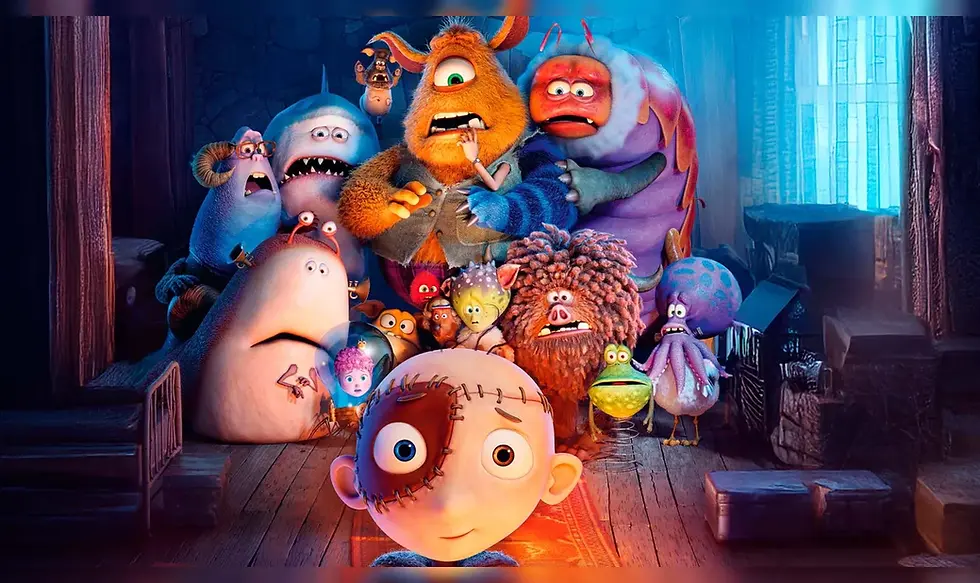
STITCH HEAD
October 31, 2025 / CosmoGO

.png)
CAST: Asa Butterfield, Rob Brydon, Alison Steadman, Joel Fry
DIRECTOR(S): Steve Hudson
High above the little town of Grubbers Nubbin, the maddest of all Mad Professors is forever creating monstrous Creations, and forgetting all about them. Left behind is Stitch Head, the Professor’s very first experiment, who quietly keeps the castle in order and the monsters in check so the townsfolk below don’t storm the gates with pitchforks.
When a failing freak show owner discovers Stitch Head, the humble little monster suddenly finds himself thrust into the spotlight as the star attraction, forcing him to confront what it really means to be seen, loved, and accepted.
Written By Eden Prosser / October 27, 2025
Rating 3 out of 5
The Halloween season is a stellar time for both treats and tricks: ghoulish fun for the whole family, heartfelt tales bordering the edge of gentle spooks. That said, it has been an unusual while since the ‘family-favourites’ cinematic canon has seen any un-boo-lievable new entries. This year’s Stitch Head, opening theatrically this week, promises the requisite combination of ‘little chills’ and ‘gentle heart,’ presenting a Hotel Transylvania-meets-Frankenstein tale of self-love and found family destined to appeal to all the littles this holiday season.
The eponymous Stitch Head (Asa Butterfield)—a Frankenstein-esque creature, humanoid, save for the stitches entangling his limbs, the patchwork comprising one side of his face—is having a personal crisis. Though he has long loved his role as the Mad Professor’s right-hand-boy, welcoming each newly-created monster to seemingly-abandoned Castle Grotteskew with gentle words and bubbly enthusiasm, as time has passed, The Professor’s lack of appreciation for his handiwork has begun to sting. When Fullburt Freakfinder (Rob Brydon), the boisterous Ringleader of a traveling circus, trespasses upon the castle, treating Stitch Head not with the fear, the disgust, he’s been led to expect from humans, but instead, with fascination, he realizes that the human world may not be as isolating as he’s long been led to believe. Desperate for external appreciation, he abandons his fellow monsters—including sweet, naive, well-meaning Creature (Joel Fry)—and retreats to the town of Grubber Nubbin to become Freakfinder’s latest headlining act.
There’s a gorgeously gothic atmosphere evoked throughout the narrative, accentuated throughout the sequences set within the castle. Swirling grays, dizzying up-the-wall camera work, coalesce into a setting as evocative as it is compelling. So, too, do the physics of the world continually fascinate: a mine cart roller coaster sequence injects a jolt of action, while literal smoke-and-mirrors provide a fitting visual foil to the later thematic locale. A lot of thought has clearly been put behind the ocular perception of the film’s wider world, the smallest details—individual bricks within the castle walls, the heterochromatic dichotomy of Stitch Head’s distinct eyes—furthering the cinematic immersion.
That said, at times, the film appears to flounder in its tailoring to its target demographic. There’s some genuine body horror wrenched through Stitch Head’s narrative: the late-act unspooling of his arm’s threads, the eventual pull of limb from self, may be disorienting for viewers of a fainter heart. Though a handful of the older-audience allusions do land—one particular Trojan Horse visual gag provides an unexpected laugh—shots of thrown bras feel out-of-place in a narrative so otherwise tailored towards children. Unfortunately, the execution of the story, too, leaves much to be desired. Both monsters and humans are consistently loud, immature; save Butterfield, whose soft-spoken performance provides a grounding anchor, the surrounding cast is overstuffed with shrieks, screams, booming proclamations; emphatic performance may be a useful tool, supplied in moderation, though when used to this extent, it begins to feel a tad overstimulating—certainly not a compelling draw for a parent or guardian’s trip to the theatre.
Like any of the animated genre’s finest, there is an undercurrent of true heart coursing through Stitch Head’s exceptional journey, as evocative as it is entirely universal. Deep down, every one of us simply wishes to be loved—to be accepted for precisely who we are. These dual themes—belonging; self-acceptance—are explored equally throughout the feature. Much of this delivery shines through, again, Butterfield’s voice performance; assured, mature, it remains the centrality that carries the film, delivering compulsion, charm, as deftly as its ebbs and cracks pull on the heartstrings. As the film reaches its apex, Creature risking his life to save Stitch Head as those he’d trusted reveal an intent to exploit his monstrosity, thematic catharsis—a realization that love can come in many forms, and true acceptance requires no conformation from who you truly are—is solidly struck, providing an exceptional entrance for the spread of such beautiful messaging.
That said, the injection of a baffling third-act plot point does marginally convolute the beauty: as the humans storm the monsters’ castle, an act brought upon by misinformed blame, misplaced rage, the monsters are told to disregard the peace they’ve long been told to display and “be whoever [they] would be if [they] were not afraid.” Inspiring, upon first glance—though any deeper reflection reveals a fray upon its edge. Is the film’s intent to convey that the monsters, deep down, remain the vicious beings the world fears them to be? A thematic beat of ‘revered humanity demonstrating a capacity for monstrosity, while the so-called monsters display nothing but kindness’ might present an interesting juxtaposition; even a message along the lines of ‘fear makes monsters of us all’ would be rife with fascination… though neither seem to be the film’s ultimate intention. Though the film’s conclusion does commit to that earlier theme of acceptance, depicting a blossoming peace between human-monster relations, thus tying back to the messaging that ‘those who love you will accept you as you are,’ the conflict of the climax seems to lack the necessary resonance to make this theme truly strike home.
Still, it’s been a long time since a feature of such atmospheric elegance has been presented for this young and vast an audience, and its visual innovation, intertwined with, yes, the heart deep at its core, prime Stitch Head as a solid theatrical option for those seeking some spooky-season magic. The underlying theme of self-acceptance is sure to elicit confidence in even the littlest of monster fans, while the maximalism of Castle Grotteskew, the fascination of the circus, present a feast for the senses, bolstered by a truly excellent musical score. Though it may lack the singularity, the nuance, of some of the animated medium’s best, it’s a fitting successor to the Hotel Transylvania or Despicable Me style of animated feature filmmaking, ushering a compelling, innovative cinematic charm for a new generation of moviegoers.