


THE PHOENICIAN SCHEME
I Universal Pictures Canada I June 6, 2025 I 101 mins. I

.png)
77%
* As of 5/23/25
CAST:
Benicio del Toro, Mia Threapleton, Michael Cera, Riz Ahmed, Tom Hanks, Bryan Cranston, Mathieu Amalric, Richard Ayoade,
Jeffrey Wright, Scarlett Johansson, Benedict Cumberbatch, Rupert Friend, Hope Davis
DIRECTOR(S):
Wes Anderson
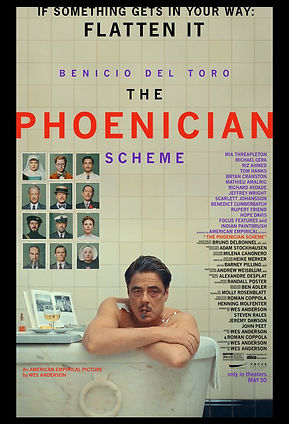.jpg)
The story of a family and a family business.
REVIEW BY: Eden Prosser - 5/25/25
RATING 4.5 out of 5
If Anderson’s recent ouvre has seen him at his most indulgent, The Phoenician Scheme, in an unexpected turn of events, is the auteur at his most accessible. Its ultimate sensibilities hearken to those of critical darling The Grand Budapest Hotel: though marginally muted, both in visual palate and, paradoxically, in scale, a pulsating thread of constant narrative eliminates contrivance—while ensuring absolute captivation. Though globe-trotting, the film feels almost quaint, achieved, perhaps, by the tight-knit composition of vignettes; it’s remarkable, the manner in which Anderson’s style lends such substance, visual attunement a language all its own.
On the surface, The Phoenician Scheme tells the tale of a flagrant businessman (Benicio del Toro), scheming to enact his titular intention for industrial advancement—a financially-conspicuous ambition, in which returns can only be provided upon completion. Faced, however, with his own mortality—a sixth assassination attempt, more narrowly-escaped than those with which he’d become acclimated—del Toro’s Zsa-Zsa Korda retreats to the nearby covenant, recruiting his estranged daughter, Liesl (Mia Threapleton), but a week from pledging herself to the sisterhood, to prove her worth as a Korda—and become the favoured heir.
So commences the Andersonian saga, transporting Korda and his kin across the kingdom of Phoenicia in a (perhaps-futile) attempt to solidify alliances, acquire financiers—and perhaps atone for a lifetime of familial estrangement in the process. Sequences are peppered with the multi-hyphenate’s signature wit; every line of dialogue is delivered with a cool tone, hefty dose of cynicism—and impressive breadth of lexicon. The Anderson hallmark, after all, is twofold; his pen is quick, his mind, masterful, the conjunction of the two primed for quite the auditory aesthetic.
Intrigue is further piqued via the mentor-mentee dual-lead, a dynamic reminiscent, once again, of Grand Budapest. Zsa-Zsa Korda may top the list of Anderson’s most colourfully compelling players: a well-intentioned, if, at times, clueless, anti-hero; a self-preserving figure whose mistakes are plenty—yet whose sense of laissez-faire endears nonetheless. Revered onscreen as both a mortal man and figure of near-myth, his reputation lingers, solidified at the apex of the Anderson character canon: del Toro was simply born for such a role. As a relative newcomer to the silver screen, Threapleton matches him with ease: her Liesl commands recognition from the first long-held stare, cool verbiage balanced by exquisite glances, shrugs, silences that speak more than words ever could. It’s an undeniable performance, one that elevates the Korda family arc to eternal excellence. Sure, a handful of supporting players feel more, at times, like name-checks than in-universe players: it’s difficult to shake the semblance of Tom Hanks masquerading as a financier—a scene-stealing moment, yes, but for a wholly distinct reason—as opposed to feeling him inhabit a novel being, offscreen persona falling away. Wright, Cumberbatch: they lean closer to the latter, near-unrecognizable as they bring their characters to life. That said, with two leads of such magnificence, perhaps this matters little.

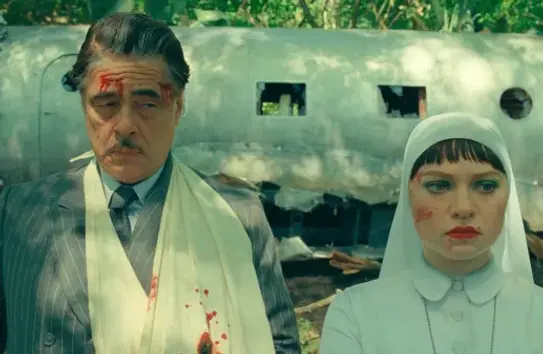
Anderson is, of course, a maestro of cinematic technicalities, aesthetic conventions—symmetry, a vibrant colour palate—intersecting with grand performance in a manner simply unforgettable. Still, what may set The Phoenician Scheme apart is the memorability of its beats: the brilliant absurdity that underlies each distinct chapter. Humour has never felt remiss in an Andersonian venture, and though The Phoenician Scheme does recognize this, so, too, does it elevate beyond anticipation. It would be improper to discuss particular exemplars, as many of the offbeat escapades function best when unexpected; that said, one particular revelation had the theatre, in its entirety, guffawing. One sequence fails to vacate the mind, cemented, eternal, in the Anderson Hall of Fame. It almost feels as though the auteur has ‘yes, and…’-ed his way through the plot’s progression; still, not once does this feel unfocused—no, each moment of absurdity slots beautifully into the narrative’s progression, simply keeping one on their toes, exhilarated to experience whatever chaos might successively ensue.
In a previous Anderson evaluation, I’d noted that, throughout this latest decade of filmmaking, “Anderson has taken the first step into a new era […] in which his primary audience is himself, where we’re simply invited to tag along for the ride.” In many ways, The Phoenician Scheme is simply a continuation of such. This time, however, we’re no longer voyeurs, peering into one man’s search for modern meaning. No, the themes that punctuate Phoenician are grand in scale: industrialization. Religion. Legacy. Phoenician, then, seems perhaps a dawning: an understanding of the various facets of life that may, above all, matter most. It seems Anderson has concluded his quest—The Phoenician Scheme, of course, his interpretation of the answer. Lucky for us, it is all-too-compelling to accept his outstretched hand, and let oneself be led, as Anderson welcomes us, once more, into his luminescent psyche.